- Published on
The Combustion Tax: How Burning Fossil Fuels Throttles Human Health
- Authors

- Name
- Shaun
We hear a lot about CO₂ as a greenhouse gas, but the danger of rising carbon dioxide levels isn't just about the climate, it's about our biology. While the environmental impact is well-documented, the direct effect of CO₂ on human health has been mostly overlooked. As industries continue to burn coal, oil, and natural gas at record rates, we can no longer ignore the quality of the air entering our lungs. Let's discuss why.
Every time a piston fires in an internal combustion engine, it consumes the very oxygen we rely on to breathe. When you multiply that single reaction by the billions of vehicles on the road, the cumulative impact becomes staggering. Combined with massive power plants that trade atmospheric oxygen for carbon dioxide through constant combustion, we are witnessing a global chemical shift: a rising tide of CO₂ and a steady ebbing of the O₂ available in our breathable atmosphere.
The Mauna Loa Observatory has been tracking this atmospheric trade for decades. This data, famously known as the Keeling Curve, provides a visual record of our changing air.
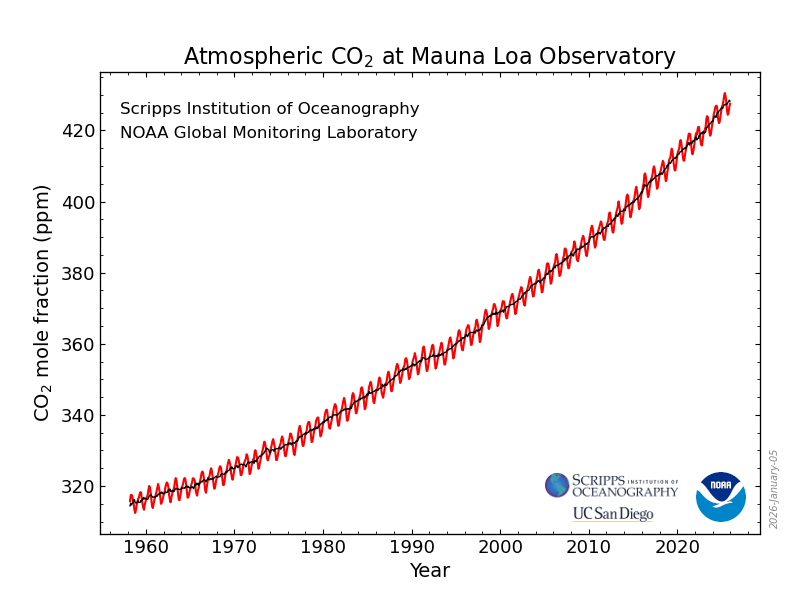
The Keeling Curve (above) has become one of the most famous graphs of the 21st century, tracking the steady rise of CO2. But there is a second, lesser-known graph that completes the story. If the Keeling Curve shows what we are adding to our atmosphere, the Oxygen Curve from the Scripps Institution shows exactly what we are losing.
While we have tracked CO₂ for decades, the other side of the equation was harder to measure. It wasn't until 1990 that the Scripps Institution of Oceanography began precisely recording the decline of atmospheric oxygen. The resulting data, often referred to as the Oxygen Curve, serves as the "smoking gun" for fossil fuel combustion.
Its significance is profound because we see a molecule of oxygen disappear for nearly every molecule of CO₂ created, we know with mathematical certainty that this shift is driven by combustion. The Oxygen Curve is the global pulse of a planet currently burning through its own life-support. An atmospheric shift that is slowly changing the very chemistry of the human bloodstream.
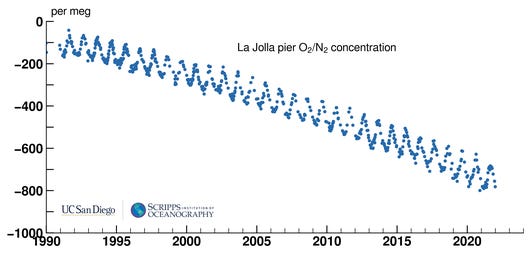 Source: Scripps Seaside Observatory at UC San Diego. (n.d.). La Jolla O₂/N₂ plot. Retrieved from scrippso2.ucsd.edu
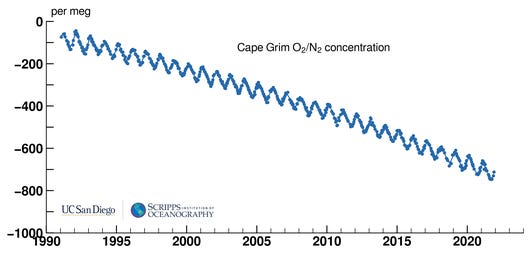 Source: Scripps Seaside Observatory at UC San Diego. (n.d.). Cape Grim O₂/N₂ plot. Retrieved from scrippso2.ucsd.edu
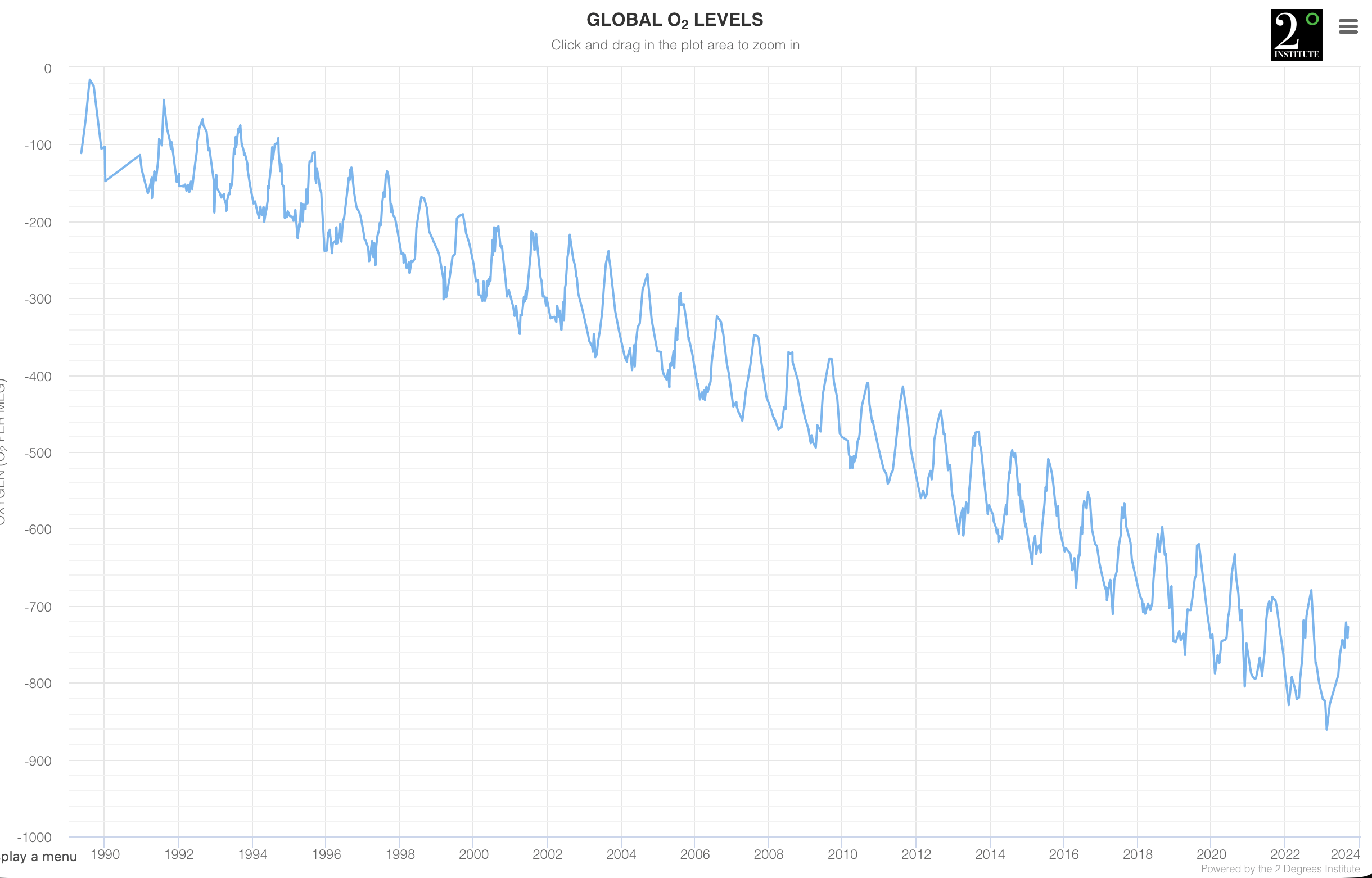 Source: oxygenlevels.org
When we align the charts for both gases, the correlation is undeniable: as carbon dioxide levels climb, oxygen levels fall in a near-perfect inverse. This reduction in breathable oxygen isn't a distant phenomenon; it's happening all around us every time a gasoline engine runs. Phasing out internal combustion isn't just a strategy for solving climate change; it's a fundamental move to protect our health. Trading our oxygen for carbon dioxide is a compromise we cannot afford to settle on. We must quickly aspire to a cleaner standard.
The Invisible Ceiling: How CO₂ Dulls the Human Mind
When we discuss trading oxygen for carbon dioxide, we aren't just talking about a chemical equation; we are talking about the fuel our brains and bodies require to function. While we focus on the CO₂ outdoors, the levels we encounter inside our homes, schools, and offices, where we spend 90% of our time, are usually even higher.
The Cognitive Tax
You've likely felt it before: mid-afternoon brain fog, an inexplicable headache, or the struggle to focus during a long meeting. This is often the direct result of Hypercapnia, an excess of CO₂ in the bloodstream.
Studies have shown that even moderate increases in CO₂ can significantly impair the executive functions of our brains. Cognitive processes like:
- Strategic Thinking: The ability to plan and execute complex tasks.
- Responding in Crisis: How quickly and effectively we react to new information.
- Information Usage: Our ability to synthesize different data points into a single decision.
Stressing the Heart (HRV)
Beyond the brain, CO₂ acts as a silent stressor on our nervous system. High concentrations of CO₂ have been shown to alter Heart Rate Variability (HRV).
When you breathe in excess CO₂, your body enters a state of mild physiological alarm. It increases both the high-frequency and low-frequency components of your HRV, signaling that your autonomic nervous system is working overtime just to maintain balance. Essentially, you are sitting still, but your body is reacting as if it is under a low-level physical threat.
The Hidden Impact on Bone Health
What might be the most surprising health concern is the relationship between CO₂ and our skeletal system. While a great deal of attention and debate has focused on things like fluoridation in water and its link to osteoporosis, the impact of CO₂ on bone density may be even more pervasive.
When we breathe in high levels of CO₂, it dissolves into our bloodstream and forms carbonic acid (H₂CO₃), leading to a condition called metabolic acidosis.
To keep your blood pH at a safe level, your body must neutralize this acid. It does this by "leaching" alkaline minerals, specifically calcium, from your bones. Over time, breathing air with higher CO₂ concentrations doesn't just affect your lungs; it may literally be weakening your skeletal frame from the inside out.
The Space Station: A Warning From a "Closed Loop"
To understand why the "Great Exchange" of oxygen for carbon dioxide is so concerning, we need only look at the most advanced laboratory in existence: the International Space Station (ISS).
Space is a hostile environment where every breath is managed by technology. Unlike Earth, where we have traditionally relied on vast forests to "scrub" our air, astronauts live in a closed system where airflow is limited and CO₂ scrubbing is a constant challenge.
10x the Limit
While we worry about outdoor CO₂ levels on Earth hitting 420 ppm, the levels on the ISS often hover around 5,000 ppm (0.5%). That is over ten times higher than the air you are breathing right now.
NASA researchers have documented that these elevated levels are not just a background stat, they can directly threaten the crew by contributing to:
- Cognitive Deficits: Difficulties with complex decision-making.
- Persistent Headaches: A common symptom of mild hypercapnia.
- Bone and Tissue Loss: The "dissolving" of skeletal integrity.
The Metabolic Ripple Effect
The data from spaceflight reveals a frightening chain reaction. We already know that microgravity causes "unloading," where bones begin to break down because they aren't fighting gravity. However, researchers are increasingly looking at high CO₂ as a "hidden accomplice" in this process.
When CO₂ levels rise, the blood becomes more acidic. To balance this pH, the body leaches calcium from the bones. This leads to a dangerous byproduct: Kidney stones.
"Kidney calcification and renal stone formation are potential byproducts because calcium is released from bone when the body is unloaded... exposure to increased levels of CO₂ can result in many health issues, including... detrimental effects on bone health."
— Nature (published in npj Microgravity, a Nature Portfolio journal, December 2022)
Why This Matters for Us on Earth
You might think, "I'm not an astronaut, why does 5,000 ppm matter to me?" The reality is that many of us already spend our days in "closed loops" just like the ISS. Poorly ventilated offices, classrooms, and bedrooms can easily spike to 1,000 ppm or 2,000 ppm by midday. We are essentially running a low-level version of a spaceflight experiment on our own bodies every single day.
But there is a more subtle, global danger: the shifting baseline of our "fresh" air.
The Narrowing Gradient: From 350 to 500 ppm
For most of human history, we lived at a baseline of roughly 280 ppm. By the 1990s, we were at 350 ppm. At our current trajectory, adding roughly 3 ppm every year, we are trending toward 500 ppm within the next 15 to 20 years.
While 500 ppm sounds low compared to the ISS, it represents a fundamental shift in human respiratory physics. Our lungs rely on a diffusion gradient: CO₂ moves out of our blood and into the air because the concentration in our lungs is higher than the concentration in the atmosphere.
As the outside air moves from 350 ppm toward 500 ppm, that "pressure hill" flattens. To compensate for this less efficient exchange, the human body must perform "additional work":
- The Heart Works Harder: To clear the same amount of CO₂ from your system, your heart must pump blood to your lungs more frequently. This increases the baseline cardiac output required just to exist.
- Respiratory Strain: Your brain's respiratory center is triggered by CO₂ levels. As the baseline rises, your "resting" breath becomes deeper or more frequent.
The Slow Creep of Exhaustion
This annual 3 ppm increase is like adding a few extra ounces of weight to a backpack every single year. You don't notice the weight change day-to-day, but over a decade, you realize you are exhausted just standing still.
By trading our planet's O₂ for CO₂ through constant combustion, we are doing more than warming the climate; we are slowly turning our entire atmosphere into a poorly ventilated room. We are forcing the human heart to work overtime simply to keep our blood at a life-sustaining pH.
Upgrading Our Life Support System
We have historically viewed the transition away from fossil fuels primarily through the lens of climate change; greenhouse gases were a distant, planetary problem. But as we've seen, this exchange of oxygen for carbon dioxide is an intimate, biological problem.
Every internal combustion engine on our roads and every coal-fired smokestack is a tiny vacuum for the oxygen we require and a pump for the gas that dulls our minds and weakens our frames. When we choose to phase out fossil fuels, we aren't just "saving the planet." We are:
- Protecting our cognitive health: Reducing the silent "brain fog" caused by rising CO₂ in our schools and workspaces.
- Defending our biology: Stopping the acidification of our blood and the leaching of minerals from our bones.
- Restoring the balance: Ending the unnecessary trade of life-sustaining O₂ for heat-trapping waste.
A Breath of Fresh Air
We have the technology to stop the trade. Electric vehicles, heat pumps, and renewable energy grids don't just reduce emissions; they stop the combustion process entirely. They allow us to move, heat our homes, and power our lives without competing with our own lungs.
Transitioning to a carbon-free future ultimately ends up being preventative medicine for our health. It is time we stop settling for an atmosphere that is slowly being depleted and start demanding one that allows us to thrive. We deserve an environment where the air is an asset, not a health risk.
The choice is simple: We can continue to burn our atmosphere, or we can choose to breathe.
Enjoyed the read? Get new posts in your inbox.
SubscribeComments
Loading comments…