- Part
- Part II: Minimalism and the Climate Crisis · Chapter 6
The Observatory
"We are releasing vast quantities of carbon dioxide. Increasing the greenhouse effect. It may not take much to destabilize the Earth's climate. To convert this heaven, our only home in the Cosmos, into a kind of hell."
‒ Carl Sagan, from the Cosmos series
At the top of Mauna Loa on the Big Island of Hawaii, an observatory quietly monitors the invisible drivers of climate change: greenhouse gases. This station collects and shares critical data on gases like methane (CH₄), carbon dioxide (CO₂), nitrous oxide (N₂O), and sulfur hexafluoride (SF₆). Of all these, the CO₂ record is especially significant ‒ it's the longest continuous direct measurement of atmospheric carbon dioxide anywhere on Earth.
Greenhouse gases are crucial to life as we know it. They act like a thermal blanket, allowing sunlight to pass through the atmosphere and warm the Earth, while trapping some of the outgoing heat to prevent our planet from freezing. But there's a catch. As the concentration of these gases increases ‒ mainly from burning fossil fuels and industrial activity ‒ more and more heat gets trapped. Light from the sun still comes in, but the heat trying to escape gets bounced back again and again by greenhouse gases, warming the Earth further. This phenomenon, known as the greenhouse effect, is not merely a theory ‒ it's fundamental physics. As Neil deGrasse Tyson put it in the Cosmos series, "It's basic physics. Just bookkeeping of the energy flow. There's nothing controversial about it."
To visualize this, imagine Earth's atmosphere as a blanket. A single layer keeps us warm and comfortable. But we've been steadily adding layers to that blanket ‒ like piling on quilt after quilt in a room that's already too warm. Eventually, it becomes suffocating. The planet can no longer cool itself effectively, and just like a person overheating under too many blankets, Earth's systems ‒ oceans, weather patterns, ecosystems ‒ begin to break down under the stress.
This warming isn't happening in a vacuum. For most of human history, CO₂ levels stayed around 280 parts per million (ppm). Today, they've exceeded 420 ppm ‒ a dramatic, unnatural rise. Scientists warn that if we don't reduce this number ‒ and soon ‒ we risk destabilizing the very climate systems that sustain life. That's why monitoring greenhouse gases is so vital: they are the pulse of the planet.
Every year in March or April, I spend time reviewing the latest data release from NOAA on annual greenhouse gas growth. You could call me an observant steward of the planet ‒ someone who, out of personal concern, checks these numbers not for a job, but out of a deep, minimalist ethic of awareness and responsibility. I'm not a climate scientist, but I believe that understanding what's happening to the Earth is a quiet, essential act of care. Greenhouse gas trends give us a high-level picture of how our collective actions are influencing the atmosphere we all depend on.
But over time, a troubling truth emerged: the trends were not improving. In fact, they were getting worse. Despite public pledges from governments and corporations to reduce emissions, the data tells a different story. Greenhouse gas concentrations are still rising ‒ year after year ‒ pushing us further from the future we need to secure, and closer to the one we fear.
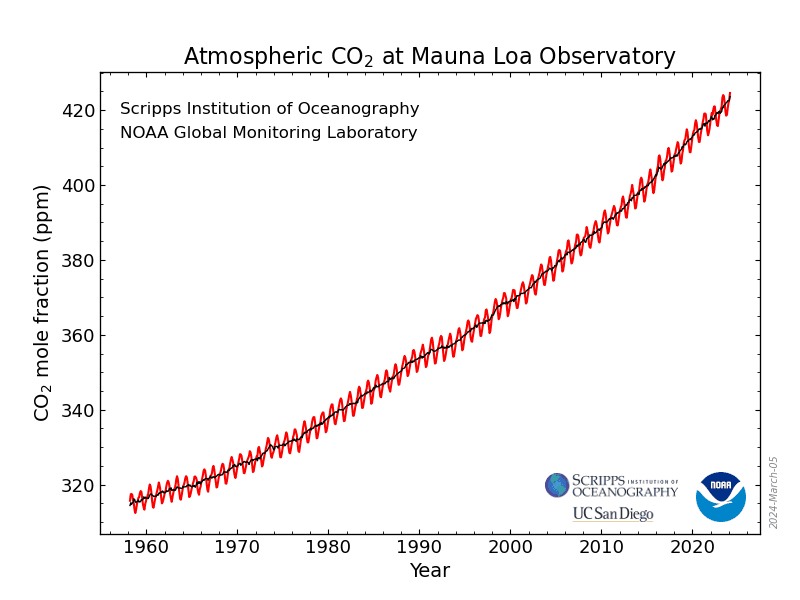
Atmospheric CO₂ at Mauna Loa Observatory: Global Monitoring Laboratory - NOAA Earth System Research Laboratories URL: https://gml.noaa.gov/webdata/ccgg/trends/co2_data_mlo.png
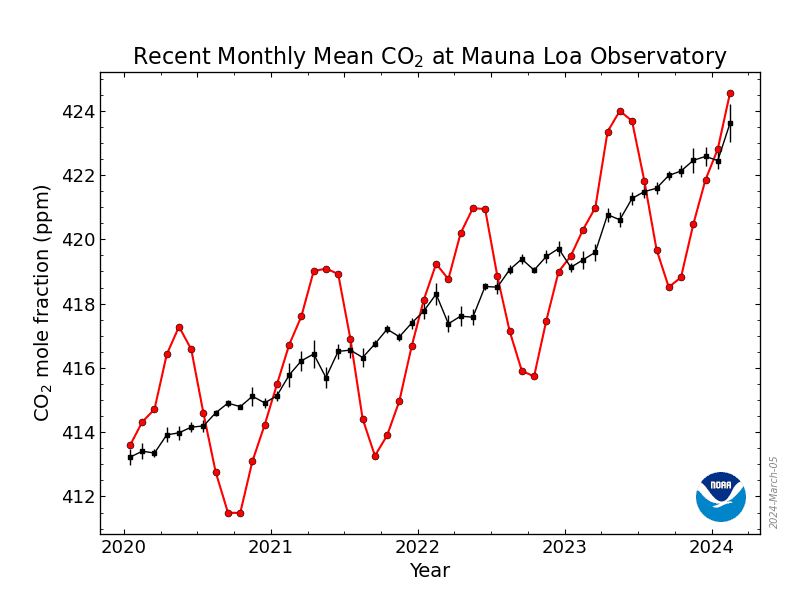
Atmospheric CO₂ at Mauna Loa Observatory: Global Monitoring Laboratory - NOAA Earth System Research Laboratories URL: https://gml.noaa.gov/webdata/ccgg/trends/co2_trend_mlo.png
The growth in other greenhouse gases aside from carbon dioxide is also alarming.
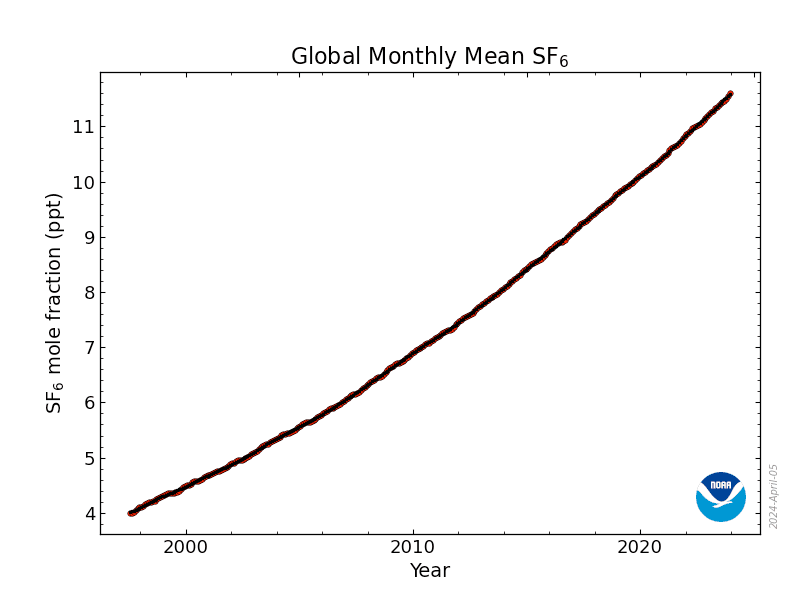
Atmospheric SF6 at Mauna Loa Observatory: Global Monitoring Laboratory - NOAA Earth System Research Laboratories URL https://gml.noaa.gov/webdata/ccgg/trends/sf6_trend_all_gl.png
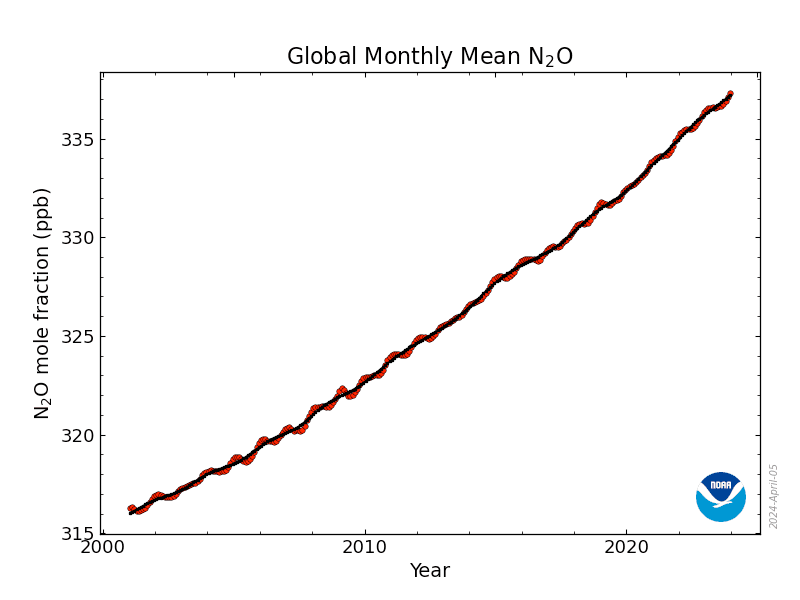
Atmospheric N₂O at Mauna Loa Observatory: Global Monitoring Laboratory - NOAA Earth System Research Laboratories URL https://gml.noaa.gov/webdata/ccgg/trends/n2o_trend_all_gl.png
Methane gas concentration growth is acutely harmful. Methane is a far more potent greenhouse gas than CO₂ when considering its 'warming potential'. Over a 100-year timescale, and without taking into account climate feedback, one tonne of methane would generate 28 times the amount of warming as one tonne of CO₂. The primary driver of methane growth is fossil fuel production and use, as well as agriculture.
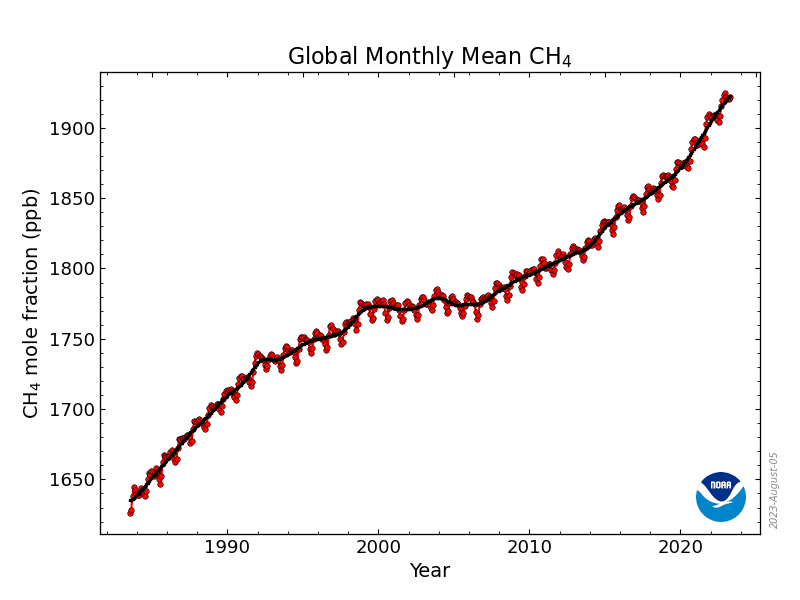
Atmospheric CH₄ at Mauna Loa Observatory: Global Monitoring Laboratory - NOAA Earth System Research Laboratories URL:https://gml.noaa.gov/webdata/ccgg/trends/ch4_trend_all_gl.png
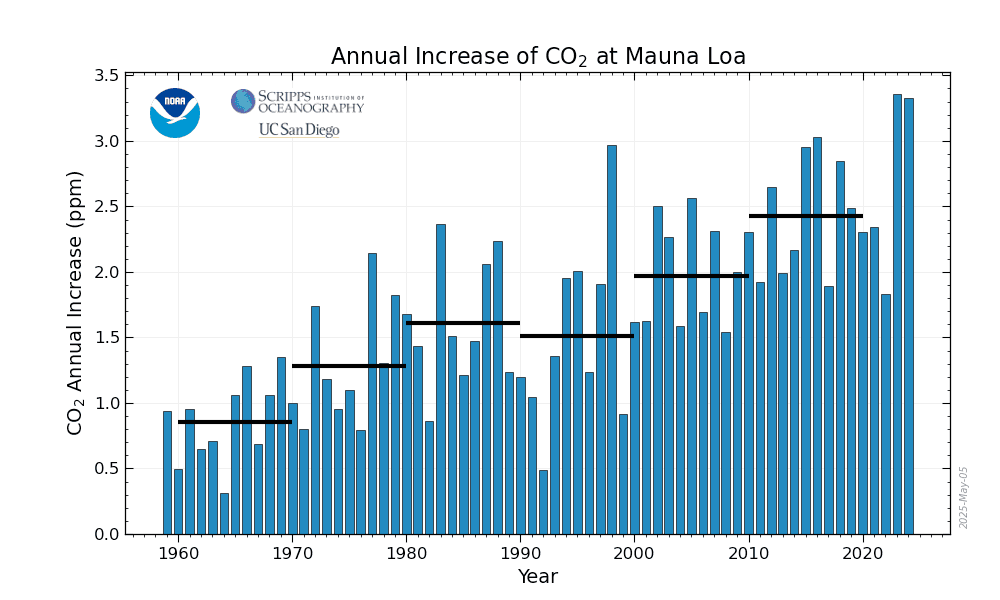
Atmospheric CO₂ Growth Rates at Mauna Loa Observatory: Global Monitoring Laboratory - NOAA Earth System Research Laboratories URL:https://gml.noaa.gov/webdata/ccgg/trends/co2_data_mlo_anngr.png
When reviewing the graphs above, pay close attention to the growth rate in emissions. This metric is more than just another data point ‒ it's a barometer of our progress (or lack thereof) in addressing climate change. The annual growth rate tells us how much more carbon dioxide we're adding to the atmosphere than Earth's natural systems can absorb. As long as the number continues to rise, we are not just falling short of stabilizing the carbon cycle ‒ we're actively accelerating the imbalance.
That's what makes the recent data so alarming. In 2023, the annual CO₂ growth rate reached the highest level ever recorded since humans began measuring it. Even more unsettling, 2024 came in a close second ‒ just a fraction behind. These aren't statistical flukes; they're red flags. Despite decades of climate talks, pledges, and technological advancements, the trajectory remains deeply off course. The charts don't lie: nothing we've done so far has bent the curve downward. We are not where we need to be. In fact, we're moving further away.
Comments
Loading comments…