- Part
- Part III: Minimalism in Practice · Chapter 15
Routine Reuse
Like most families during the COVID-19 pandemic, we were mostly confined to our home and our immediate surroundings for about two years. The world had changed quite a bit during that time. One of the most concerning developments during the pandemic was the proliferation of plastic.
Plastic consumption rose to an all time high during the pandemic. Big Oil companies were delighted. Despite us using less fossil fuels to power our vehicles or airplanes we used a significant amount of oil to make the plastic used in our to go boxes and food packaging. The graph below shows the total annual production of global plastics over time. It's important to highlight that the amount produced ends up being the amount consumed. When you think of oil, it's helpful to remember oil is plastic and plastic is greenhouse emission growth and endocrine system disruption. This is why, as minimalists, our choices are so paramount to actual reduction efforts.
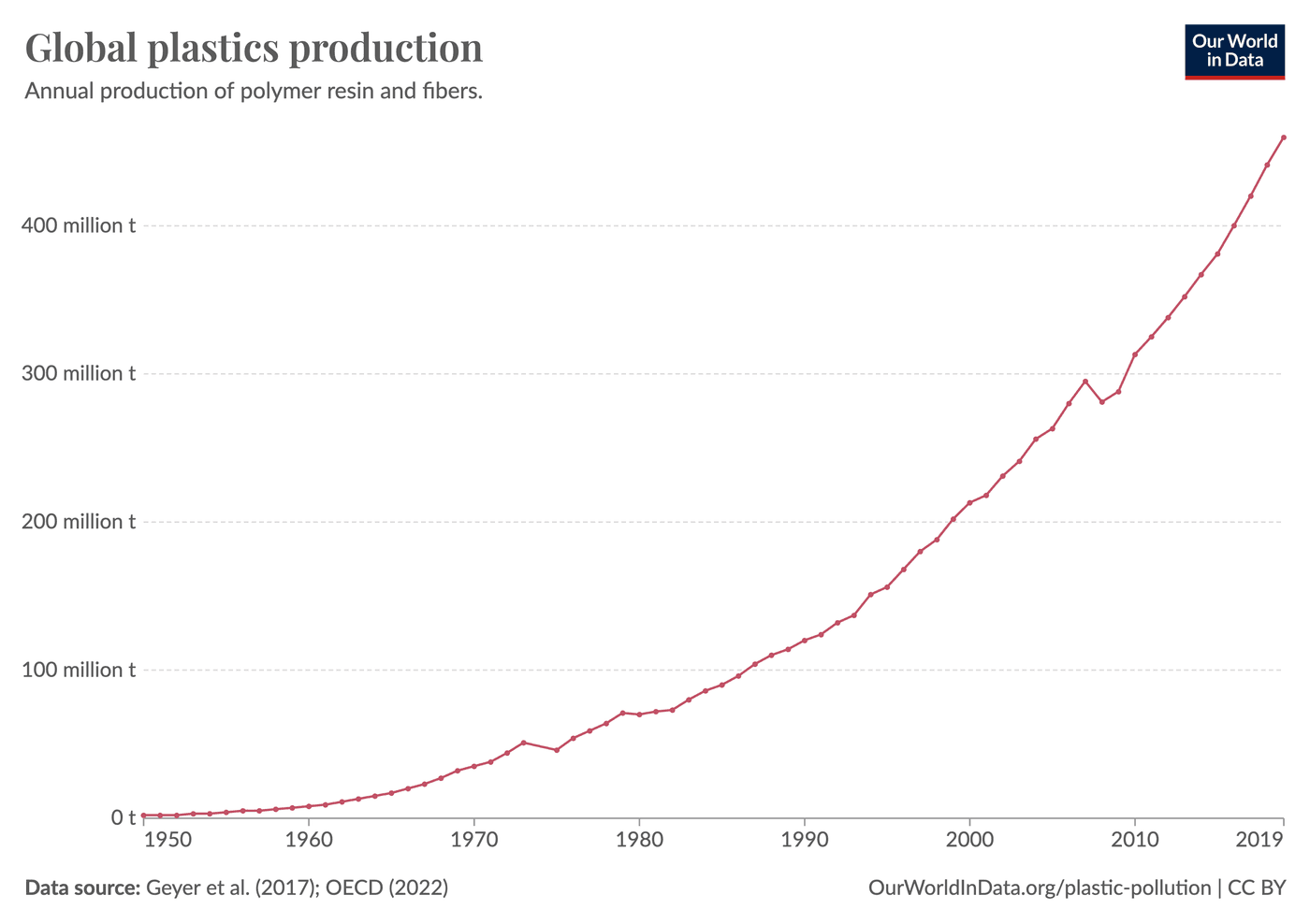
"Data Page: Global plastics production", part of the following publication: Hannah Ritchie, Veronika Samborska and Max Roser (2023) - "Plastic Pollution". Data adapted from Geyer et al., OECD. Retrieved from https://ourworldindata.org/grapher/global-plastics-production [online resource]
The Over Consumption of Plastic
As the pandemic largely started to subside I began to make plans with my family to go on a rejuvenating trip. We had been confined at home for so long with no chances to even leave for work. This journey would be the first time we left home for more than a day, in what felt like an eternity. We chose to go to Hawaii. Hawaii's beauty is magnificent. It's difficult not to feel complete awe the first time you see its beaches.
One weekend my mother, my partner, and I went to Lanikai Beach in Kaʻōhao, a community in the town of Kailua on the windward coast of Oahu. I was out swimming a bit past where the waves broke along the shore. The water was relatively calm and I could see through the surface layer down a few feet. I noticed some chips of something spread throughout the water. I didn't know what exactly it was. I tried to capture it with my hands but it was elusive, as I swept my hands through the water it kept evading my grasp. Eventually I was able to capture it realizing what it was. A piece of plastic. Pieces of plastic could be found all through the water. It hit me quite hard. I tried to grab as many pieces as I could before I went back to the shore. As I walked back from the water to the sand to sit with my family with pieces of plastic in hand, I noticed something unexpected. Along the edges of where the deepest waves had pushed water upwards along the shore before receding back to the ocean, there were plastic fragments nestled between branches and grass that lie along the sand.
There I stood with my family in one of the most beautiful places on Earth. I had felt so happy for a fleeting moment that day. My joy had shifted into concern; the reality of plastic pollution disturbed me. Such an unsettling feeling came over me as I had not felt before. The magnitude of the problem exceeded even my darkest expectations. Here, at one of the most remote places on our planet, plastic pollution was ubiquitous.
Reuse disposables when you're able to. Avoid getting beverages in single use cups or containers. Don't just use that plastic cup once. If you have to use it amortize the waste as much as possible before final disposal. Try to bring your own bottles, mugs, cups etc whenever possible. If you do end up having to use a disposable container or utensil try not to throw it away after a single use.
Whenever possible try to reduce your plastic exposure by utilizing a good set of glass tupperware containers. Glass or aluminum containers are the easiest to reuse multiple times to amortize their production's energy cost. Bring a glass food storage container with you in your car or backpack to use if you ever need to bring unfinished food home. Buy a bamboo utensil kit. Use a reusable bamboo straw.
If you got something to go and it was wrapped in foil, keep the foil and reuse it a few times until it can no longer be used.
Even if something is recyclable most of the plastic that ends up in the trash will not be turned into new plastic things. Most of it is buried in nearby landfills. If it isn't stored there it will be exported to a country willing to bury it there instead. This requires even more energy to be consumed further damaging our air and water supplies. The burning of fossil fuels generated at ports and during maritime transit releases considerable amounts of harmful particulate matter.
Despite what the oil and gas companies tell us, plastic trash isn't valuable, and it never has been. The makers of plastic ‒ the nation's largest oil and gas companies ‒ have always known this, even as they spent millions of dollars telling the American public the opposite. The industry's awareness that recycling wouldn't keep plastic out of landfills and the environment goes back to the early days "There is serious doubt that [recycling plastic] can ever be made viable on an economic basis," one industry insider wrote in a 1974 speech. Selling recycling sold plastic, even if recycling is a myth. According to the insider report, "There is no recovery from obsolete products. Plastic degrades with each turnover."
Moving Past Single Use
If ever getting a plastic cup or plastic utensils then try to reuse them. Every time something is reused without another consumed then that is an opportunity to reduce consumption and impact on the planet. Reuse plastic disposable silverware. Make one time use many use. Reduce the amount you acquire. Never take more sauce packets or small plastic containers for this on the side or that on the side. With every extra piece added to an order, the amount of waste generated increases that much more. Focus on reuse and waste reduction. This will help bring down the amount of plastic you're exposed to. It will also reduce the amount thrown away from sole sustenance.
The impact that the production of the disposable item would have on the environment is lessened and amortized the more times you are able to use it without consuming another disposable product. For every reuse there is less new disposable products needed and less will end up in plastic and the food we consume or the drinks we have. For single use plastics, try to use them as many times as possible to amortize their environmental cost. Single use can become multiple uses. Single use disposables can even become nearly non existent in your life once replaced by healthier reusable products. However, when it comes to goods and things that you no longer need do not hoard. Shed yourself of these things. Moving on from them as soon as the need passes.
Samples
When restaurants serve little condiments with a meal why can't they just use paper cups? Same thing with food samples that will quickly be consumed. Avoid samples that are presented in single use plastic containers. If something is to be consumed within a short period of time, it could just as easily have been put in a thin paper cup instead.
Paper cups are typically biodegradable and, when made without plastic linings, are easier to recycle or compost compared to plastic cups, which contribute to plastic waste and pollution. However, many paper cups require a plastic or wax coating to handle liquids, complicating recycling. Recent innovations in biodegradable and compostable coatings are improving this though.
While plastic cups are favored for their durability, clarity, and cost, paper cups offer significant environmental and branding advantages, especially as consumer and regulatory pressures push for more sustainable solutions. Businesses could instead choose paper cups if they prioritize sustainability and seek to be more appealing to minimalist customers, particularly when liquid beverages and other products are not the primary offering.
Plastic Bottles
Plastic pollution is no longer confined to oceans or landfills. It has evolved into something far more insidious: microplastics. These are tiny fragments ‒ less than 5 millimeters in size ‒ released from packaging, synthetic fabrics, tires, and everyday plastic products. Once in the environment, they are carried by wind, absorbed into clouds, and returned to the ground through rain, snow, and fog. Microplastics have become embedded in the air we breathe, the water we drink, and the food we eat ‒ marking a disturbing shift in how deeply plastic has permeated the natural world and our daily lives.
Avoid drinking from plastic bottles like the plague. Recent studies showed one plastic bottle has roughly 100,000 pieces of microplastics in it. "Micro-nano plastics concentrations were estimated to be about 2.4 ± 1.3 × 10^5^ particles per liter of bottled water, about 90% of which are nanoplastics,"N. Qian, X. Gao, X. Lang, H. Deng, T.M. Bratu, Q. Chen, P. Stapleton, B. Yan, W. Min, Rapid single-particle chemical imaging of nanoplastics by SRS microscopy, *Proc. Natl. Acad. Sci. U.S.A.*121 (3) e2300582121,
https://doi.org/10.1073/pnas.2300582121 (2024).
What is a microplastic anyway? It's anything smaller than five millimeters in size (5,000 microns). A one-liter bottle contains as many as 240,000 plastic fragments. This isn't applicable to just water bottles but for any beverage stored in a plastic bottle. Although the amount of microplastics might differ from one drink to the next. The overall concern applies broadly to all plastic drinks. I believe the following analogy is so useful when it comes to ingesting microplastics.
"If you've ever had chili or spaghetti and you put it in Tupperware, and you can't scrub the orange color out, that's a manifestation of how plastics absorb oily chemicals," says Liboiron, director of the Civic Laboratory for Environmental Action Research (CLEAR), which monitors plastic pollution.
It is vital to protect the health of our endocrine system by avoiding plastic packed beverages. Protect your hormones by avoiding plastic bottles.
Groundwater Declines
Groundwater levels are decreasing across much of the world. Over the last 100 years groundwater levels have dropped by as much as 10 to 30 meters (30 to 100 feet) in some regions, especially in areas of intensive agricultural and industrial use, such as parts of the United States, India, and China. The World Resources Institute estimates that global groundwater depletion has doubled since 1960 due to population growth, industrialization, and irrigation.
Over the last 50 years, groundwater depletion has accelerated, with some aquifers experiencing drops of 1 to 3 feet per year in high-use regions. When we hear about the importance of reducing the amount of water we waste the first thing that comes to mind is how sad it is to throw away so much water needlessly.
Reuse should become a habit, it extends beyond reusing disposables. We can strengthen our inclination towards reuse by owning reusable containers. There are countless ways to reduce water waste. Primarily through integrating reuse practices into our daily lives. For example, reusing dishes and plates before putting them into the dishwasher, reusing water itself through collecting it then integrating it as an alternative to fresh water when applicable.
Glass Bottles
An important concept minimalists need to remember is that consumption alternatives have their own significant drawbacks. The only true way to make a difference is to avoid consuming an item altogether no matter how it's marketed. The most crucial true reductions come from not consuming something altogether or from utilizing a reusable tool that outlives the higher up front carbon cost. This is where reusable bottles, straws, and bags etc come into play. Up front there is a higher sunk cost, but if it's amortized over extended periods of reuse the savings can be significant. Every piece of plastic we have interacted with in life will end up being around longer than our own bodies will.
This brings us to glass bottle reuse. When you get a drink in a glass bottle keep it around for a bit after you have finished it. These bottles can be used for a while instead of other cups or containers when going out or at home. You can bring the glass bottle with you and refill it with water or other beverages instead of disposing of it right away. Recycling takes energy; using something a few more times already in your possession saves energy by preventing the creation of more material for the alternative you would have used instead.
Hot Drinks, to go?
Avoid getting hot drinks in paper cups lined with plastic. Many paper cups are coated with a thin layer of plastic lining to make them waterproof and resistant to liquids. This is because without sufficient coating, paper cups may not hold up well for extended periods when holding liquids. When hot beverages are poured into these cups, especially if the temperature is high, there is a risk of plastic components migrating from the cup lining into the beverage. This can result in the transfer of microplastics from the cup to the drink.
Hot beverage containers often come with additional plastic components such as stirrers, lids, or sleeves. These accessories may contain or shed microplastics, which can then contaminate the beverage when used or come into contact with the hot liquid. Avoid using plastic stirrers, lids, or other accessories with hot beverages.
Opt for reusable cups or containers made from materials that do not contain plastic linings.
Putting It Into Practice
What you can do today:
- Carry a reusable bottle, mug, and set of utensils so you can decline single-use cups, straws, and cutlery.
- Reuse what's already in hand ‒ rinse and refill a glass jar or bottle, or save foil and containers for another use before recycling.
- Skip the extra sauce packets, lids, stirrers, and napkins you won't use.
Longer-term shifts:
- Build a small kit of durable replacements ‒ glass storage, a bamboo utensil set, cloth napkins ‒ for the disposables you reach for most.
- Favor drinks and food in reusable glass or aluminum over plastic bottles and plastic-lined cups.
- Ask cafes and stores to accept your own containers and to offer paper or refillable options.
By the numbers:
- Plastics account for about 3.4% of global greenhouse gas emissions across their lifecycle ‒ around 1.8 billion tonnes of CO₂-equivalent a year ‒ and roughly 90% of that comes from producing new plastic from fossil fuels (OECD, Global Plastics Outlook, 2022). Every disposable reused instead of replaced keeps that new-production footprint in the ground.
- A reusable glass or aluminum container earns back its higher manufacturing cost after only a handful of uses; refill-and-return systems can cycle a single glass bottle up to about 50 times, spreading its footprint thinner with every reuse.
Comments
Loading comments…